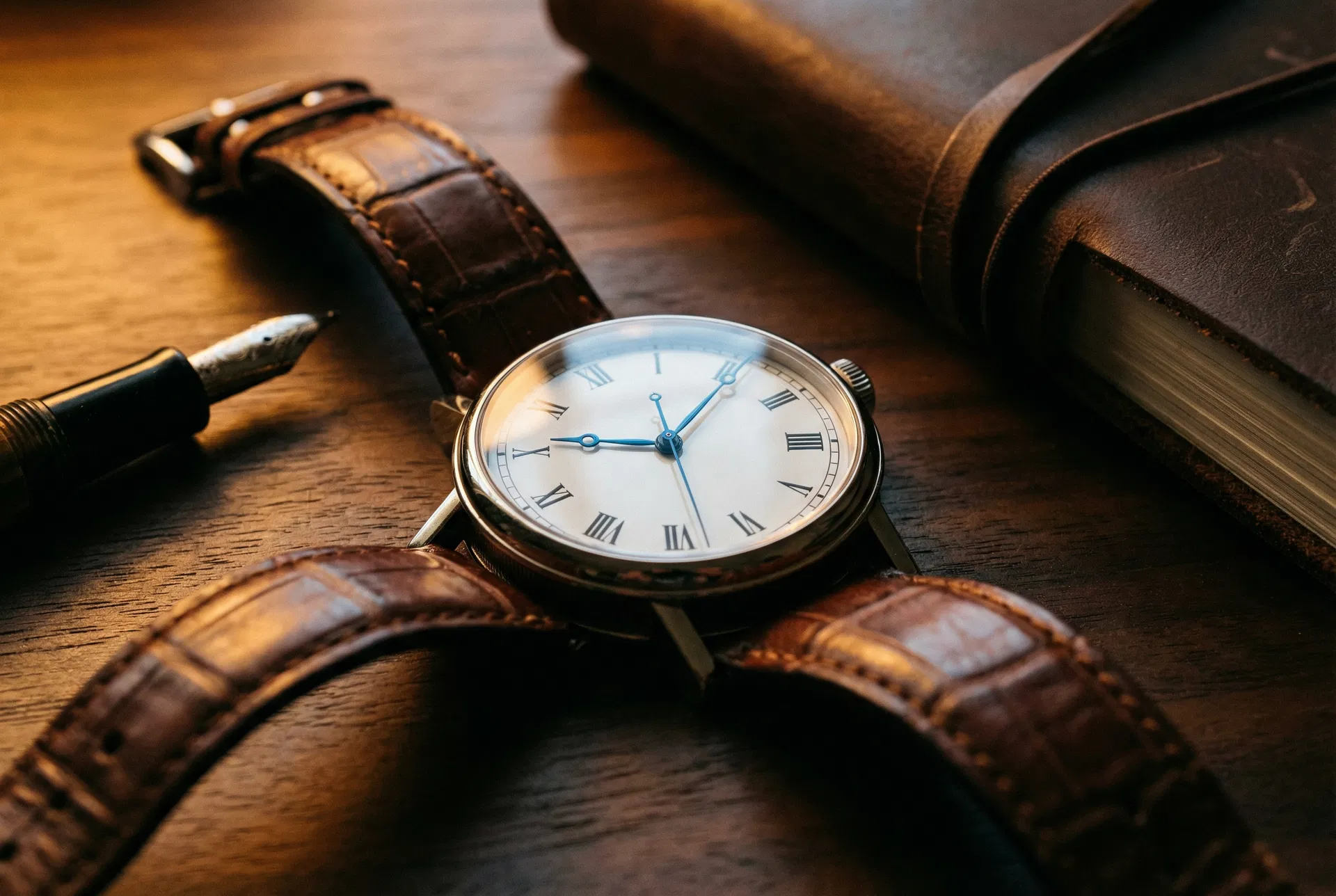



The air in Henrik Lindqvist’s atelier, tucked away on a quiet street in Geneva’s old town, is a curious mixture of ancient and modern. It carries the faint, metallic scent of precision machinery and fine oils, layered over the warm, reassuring aroma of old wood and worn leather. Sunlight streams through a large, unadorned window, illuminating a space that is both a surgeon’s theatre and an artist’s studio. Here, amidst the quiet hum of lathes and the gentle ticking of escapements, the austere principles of Scandinavian design are brought to bear on the rich traditions of Swiss horology.
At the centre of this world is Henrik Lindqvist himself. A tall, thoughtful Swede with a quiet intensity, he seems perfectly at home in this sanctuary of meticulous craft. After honing his skills in the hallowed workshops of Patek Philippe, Lindqvist felt a pull towards a more personal form of expression. He left the world of grand complications and established his own independent atelier, a place where he could create timepieces that spoke in his own, distinct voice—a voice that whispers of Nordic landscapes and celestial wonders.
The results of this vision are objects of singular beauty. Lindqvist produces a mere twelve pieces a year, each one a testament to his uncompromising philosophy. The dials are studies in restraint, often featuring only the most essential markers. The complications are less about data and more about poetry. And the cases, carved from fragments of meteorite, possess a texture and a story that is literally out of this world. With prices ranging from £80,000 to £250,000, these are not mere watches; they are heirlooms, talismans, and intimate expressions of a singular artistic vision.
A Conversation with the Master
Larizia: Your journey into watchmaking is quite unique. What led you from the storied workshops of Patek Philippe to establishing your own independent atelier?
Henrik Lindqvist: I have the deepest respect for the history and the craft I learned at Patek. It is the foundation of everything I do. But within such a revered institution, you are a guardian of a legacy, a specific, beautiful tradition. I reached a point where I felt a strong internal need to not just preserve tradition, but to create my own. It was a desire for a more direct, unfiltered conversation between the material, the mechanism, and my own artistic sensibilities. The freedom of being independent allows for that dialogue. It’s a terrifying freedom, at times, but an essential one.
Larizia: Scandinavian design is a clear influence in your work. How do you translate principles of minimalism and functionality into something as mechanically complex as a watch?
Henrik Lindqvist: It’s about distilling the essence of time-telling. In Scandinavian design, whether it’s a chair or a building, the first question is always about function, but the second, equally important question is about its soul, its feeling. I reject ornamentation for its own sake. Every line, every finish, every component must have a purpose. A clean dial isn’t empty; it’s calm. It allows the movement of the hands, the passage of time itself, to be the focus. It’s a process of reduction to find the purest expression.
For me, a watch dial is like a silent room. You can fill it with noise and clutter, or you can leave it open, allowing for a single, beautiful note to resonate. I always choose the single note.
Larizia: Let’s talk about the materials. You’re known for using meteorite for your cases. What draws you to this extraterrestrial material?
Henrik Lindqvist: It is the story, first and foremost. To wear a piece of a star on your wrist is a powerful concept. This material has travelled through the cosmos for billions of years to end up here, in my workshop, and then with its final owner. Technically, it is a nightmare to work with. It’s brittle, unpredictable. But when you succeed, and you polish it to reveal the Widmanstätten patterns—those unique, crystalline structures—you have something that can never be replicated. Each case is as unique as a fingerprint. It is nature’s engraving.
Larizia: Your complications are often described as ‘poetic’. Can you give us an example of a complication you’ve developed and the story behind it?
Henrik Lindqvist: I created a piece for a client called the ‘Vintergatan’—the Winter Street, which is the Swedish name for the Milky Way. Instead of a traditional moonphase, it has a small, dark aventurine disc that rotates over a 24-hour cycle. During the day, it is just a deep, starry blue. But at night, tiny platinum flecks and a few microscopic diamonds catch the light, creating a subtle, shimmering representation of our galaxy. It doesn’t tell you the phase of the moon in a practical sense, but it aims to give you a feeling, a connection to the night sky. It’s a quiet complication, for personal reflection.
Larizia: Who is the Henrik Lindqvist collector? What do you think draws them to your work?
Henrik Lindqvist: I believe they are individuals who have a deep appreciation for the human hand. They are not looking for a status symbol in the conventional sense. They are looking for a personal connection to an object, to the story of its creation. They are often people who are leaders in their own fields—architects, musicians, writers—who understand the dedication required to create something of lasting value. They are buying a piece of my philosophy, my time, and my passion.
The person who wears my watch is not interested in shouting. They are interested in a quiet, confident statement of their own values: a respect for craft, an appreciation for the unusual, and a love for stories.
Larizia: What does the future hold for your atelier? Do you have any plans to expand or change your approach?
Henrik Lindqvist: To expand would be to dilute the very thing that makes this work special. The limit of twelve pieces per year is not a marketing strategy; it is the reality of the time and focus each watch demands. My plan is to go deeper, not wider. To explore more challenging materials, to develop new, quiet complications, and to continue refining my craft. There is a lifetime of work in that pursuit alone. The goal is not to build an empire, but to perfect a single, beautiful expression of time.
Precision and Poetry
As our conversation ends, Lindqvist turns back to his workbench. He picks up a minuscule component with a pair of tweezers, his focus absolute. The afternoon light catches the meteorite case of the watch he is assembling, and for a moment, the ancient, cosmic pattern seems to pulse with a life of its own. Here, in this small Geneva workshop, the vastness of space and the intimacy of the human touch are brought together in a perfect, ticking harmony. It is a place where precision is not just a technical requirement, but the very language of poetry.